

Do You Really Need a Daily Probiotic?
Why I stopped chasing the “right” one—and started focusing on the terrain instead

I used to be really into probiotics. Especially the spore-based kind.
Between the internet and my own training, the message was pretty clear: find the right one, take it daily, fix your gut.
But the more I study the microbiome, the more that story feels too neat for something this personal.
Your gut is not a blank slate. It is a living ecosystem that has been shaped by your whole life and honestly, by the lives before you.
Where your family came from.
What foods were normal growing up.
What your nervous system has lived through.
What your light environment looks like.
How much time you spend outdoors.
Whether you were born vaginally or by C-section, breastfed, bottle-fed, on antibiotics as a kid, the whole thing.
Two women can take the exact same probiotic and have totally different outcomes, because they are starting from totally different terrain.
And science is catching up to that reality.
Which means if probiotics never “worked for you,” you’re not broken. Your gut might just be selective.
Just to be clear: I’m not anti-probiotic. I’ve seen them help real people in specific situations. I’m just increasingly skeptical of the “everyone, every day, same capsule” idea.
One of the big “oh” moments for me came from studies showing that probiotics face something called colonization resistance.
Meaning: your existing microbiome is not just sitting there waiting for new strains to move in.
Even if we all know they don’t move in permanently, the bigger point is that the short-term response isn’t predictable either. Some guts barely let them land, some host them briefly, and some get shifted in ways that aren’t necessarily helpful.
It’s like the lunch tables during your awkward junior high years (anyone else?). At some tables, anyone can take a seat. Others…not so much.
And you can’t tell which “lunch table” (yes, we’re still talking about the microbiome in case I’ve lost you) is welcoming of outsiders just by glancing.
In a 2018 Cell study, different people who took the same multi-strain probiotic showed completely different patterns. Some strains barely stuck around in certain people. Others colonized temporarily. What predicted it was not the probiotic. It was the person’s baseline gut and host features (Zmora et al., 2018).
That alone makes the “everyone should take this one probiotic daily forever” idea feel a little shaky.

A Healthy Microbiome Is Not One Single Picture
This part matters a lot to me, and is directly tied to my earlier point about your ancestors.
There is no universal “right” microbiome that all humans are supposed to have.
When researchers look across the world, they find huge differences in what “normal” looks like depending on geography, diet, lifestyle, and environment.
A gut that is healthy for someone in rural Tanzania will not look the same as a gut that is healthy for someone in suburban Virginia. And that is not a flaw. That is adaptation (Gupta et al., 2017).
Even within the same country, microbiomes differ in measurable ways by ethnicity and cultural food patterns, which are often echoes of ancestral diets and environments (Dwiyanto et al., 2021).
So if you are sitting there thinking “my gut should look like the gold standard microbiome chart,” the science is basically like: there is no single chart🤪.
Different ecosystems can be healthy in different ways.

And one more environmental variable that’s weirdly under-talked-about: light. A 2020 paper highlighted human data showing that UVB exposure to the skin may shift the gut microbiome, increasing diversity and changing the big bacterial groups that dominate the ecosystem. The authors even point to a “skin–gut axis,” basically saying sunlight habits belong on the list of things that shape what your gut looks like and how it functions (Conteville & Vicente, 2020).
As a nerdy footnote, this also makes sense from the microbe side: even bacteria like E. coli use blue light as a signal that changes their behavior. So light shaping the microbiome isn’t just a “human hormone” story. Microbes themselves are built to notice light cues too (Perlova et al., 2019).
What seems to matter most is not all having the same bacteria, but having a community that is resilient, diverse enough, and doing its jobs well for your body.
Here is the study that really made me stop and recalibrate.
In another 2018 Cell paper, researchers looked at people after antibiotics. One group took a common multi-strain probiotic. Another group took nothing and let their gut recover on its own. The group that took nothing returned to their baseline microbiome faster. The probiotic group had delayed and incomplete recovery for months (Suez et al., 2018).
(Quick note: these two Cell studies are companion papers. One shows probiotics colonize people differently. The other shows that right after antibiotics, they can slow recovery.)
So in that context, “helping” the gut by adding strains right away often slowed its natural reboot in this study.
Again, that is not “probiotics are bad.”
It is “timing and context matter more than we have been told.”

The Way I Think About It Now
If probiotics are like seeds, then most of us are trying to throw seeds onto soil we have not tended.
We are adding bacteria without asking:
Is the environment one that lets beneficial bacteria thrive?
Is the gut lining inflamed?
Is sleep upside down?
Are we grazing all day with no rest window for the gut?
Are stress hormones running the show?
Is night basically a second daytime in the house?
Because if the “soil” is off, the seeds are not the solution.
So I have stopped chasing the “right” probiotic as a default.
I am more interested in foundations that help your own ecosystem rebuild itself in its own way:
Fiber and plant diversity if tolerated
Resistant starch and polyphenols
Fermented foods when they feel supportive
Meal spacing so the gut has a repair window
Morning daylight and real darkness at night, because yes, your gut clock listens to light too
Nervous system downshifts, because stress literally changes microbial balance
Not in a perfectionist way. In a “what would help your body re-grow what actually belongs there” way.
Real-life take:
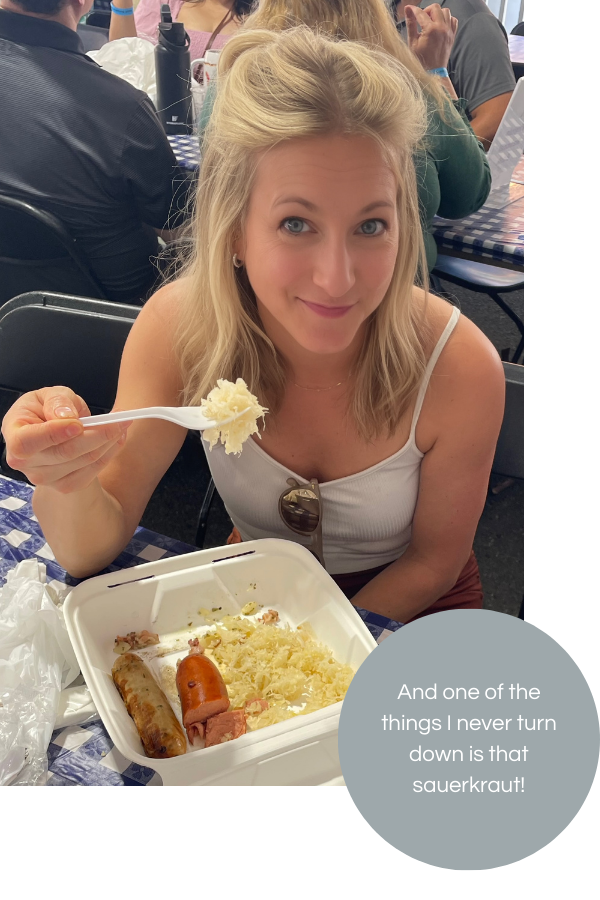
Flavored sauerkraut is one of my favorite ways to get probiotics in. It should come from the refrigerated section of the grocery store (or you can make it at home), and even the smallest amount can be added on top of almost anything. You really don’t need much (think about how tiny those microbes are!) I love putting it on eggs, salads, bowls…you name it. I especially love the beet lemon flavor.

(because I promise, I’m not trying to be dramatic about this)
Probiotic supplements can be genuinely helpful in the right context. A lot of the literature is strain-specific for a reason: certain bacteria do certain jobs well. Some strains help reduce antibiotic-associated diarrhea, calm specific IBS patterns, support gut barrier signaling, or even nudge mood and stress pathways through the gut-brain axis. That research isn’t fake. It’s just narrower than wellness culture makes it sound. And if you do decide (ideally with a practitioner) that a probiotic makes sense, quality and strain selection matter a lot. These aren’t interchangeable “just grab anything off the shelf” capsules.
What often gets missed is the role probiotics usually play. It’s not that probiotics never help. It’s that they’re more like a temporary guest who brings a casserole (and maybe some weird, yet appreciated convos), not a permanent roommate. They come over, feed the crowd, lift the mood a bit, save the day… but then they leave. And real life returns.
Most strains don’t permanently move in, and even while they’re passing through, their effects depend on the terrain they land in. The same probiotic can feel supportive in one gut, neutral in another, and disruptive in a third.
Not because the probiotic is “bad,” but because ecosystems are personal.
This includes spore-based probiotics too. They’re more resilient (they survive the stomach better and can do useful work while they’re around), and I’ve seen them help plenty of people when there’s a clear reason and the timing is right. But “hardy” still doesn’t mean “universal.” Spores interact with a very individual microbiome, so they’re not a forever default. I consider them more like a targeted tool or short-term bridge when the body needs one, not a daily multivitamin.
So I’m not anti-probiotic. I’m anti one-size-fits-all probiotic culture. I used to be very pro, and I still use them selectively with the right person at the right time. I’m just no longer convinced that the “everyone take one forever” story matches the science.
Your microbiome isn’t supposed to look like mine, or your neighbor’s. It’s supposed to look like YOU. Shaped by your biology, your history, your environment, and yes, your lineage. And ecosystems recover best when we stop forcing sameness and start supporting conditions.
Friendly reminder: none of this is medical advice. I just share science and patterns I see in real life.

If you found this interesting or have any thoughts around the probiotics world, I genuinely love hearing other perspectives. Feel free to leave me a comment below.
Plus, connection from you all is what keeps me going, so please say “hi” if you feel so inclined. Thanks for taking the time to read!
Sources:
Conteville, L. C., & Vicente, A. C. P. (2020). Skin exposure to sunlight: A factor modulating the human gut microbiome composition. Gut Microbes, 11(5), 1135–1138. https://doi.org/10.1080/19490976.2020.1745044
Dwiyanto, J., Hussain, M. H., Reidpath, D., Ong, K. S., Qasim, A., Lee, S. W. H., Lee, S. M., Foo, S. C., Chong, C. W., & Rahman, S. (2021). Ethnicity influences the gut microbiota of individuals sharing a geographical location: A cross-sectional study from a middle-income country. Scientific Reports, 11(1), 2618. https://doi.org/10.1038/s41598-021-82311-3
Gupta, V. K., Paul, S., & Dutta, C. (2017). Geography, Ethnicity or Subsistence-Specific Variations in Human Microbiome Composition and Diversity. Frontiers in Microbiology, 8, 1162. https://doi.org/10.3389/fmicb.2017.01162
Perlova, T., Gruebele, M., & Chemla, Y. R. (2019). Blue Light Is a Universal Signal for Escherichia coli Chemoreceptors. Journal of Bacteriology, 201(11), e00762-18. https://doi.org/10.1128/JB.00762-18
Suez, J., Zmora, N., Zilberman-Schapira, G., Mor, U., Dori-Bachash, M., Bashiardes, S., Zur, M., Regev-Lehavi, D., Ben-Zeev Brik, R., Federici, S., Horn, M., Cohen, Y., Moor, A. E., Zeevi, D., Korem, T., Kotler, E., Harmelin, A., Itzkovitz, S., Maharshak, N., … Elinav, E. (2018). Post-Antibiotic Gut Mucosal Microbiome Reconstitution Is Impaired by Probiotics and Improved by Autologous FMT. Cell, 174(6), 1406-1423.e16. https://doi.org/10.1016/j.cell.2018.08.047
Zmora, N., Zilberman-Schapira, G., Suez, J., Mor, U., Dori-Bachash, M., Bashiardes, S., Kotler, E., Zur, M., Regev-Lehavi, D., Brik, R. B.-Z., Federici, S., Cohen, Y., Linevsky, R., Rothschild, D., Moor, A. E., Ben-Moshe, S., Harmelin, A., Itzkovitz, S., Maharshak, N., … Elinav, E. (2018). Personalized Gut Mucosal Colonization Resistance to Empiric Probiotics Is Associated with Unique Host and Microbiome Features. Cell, 174(6), 1388-1405.e21. https://doi.org/10.1016/j.cell.2018.08.041